A gym handles all kinds of personal data: names, tax codes, contact details and often health-related data such as medical certificates. With cloud software that data sits on another company’s servers, and that company becomes a processor acting for you: you need a written agreement, you need to know where the servers are, who else has access and what happens in a breach.
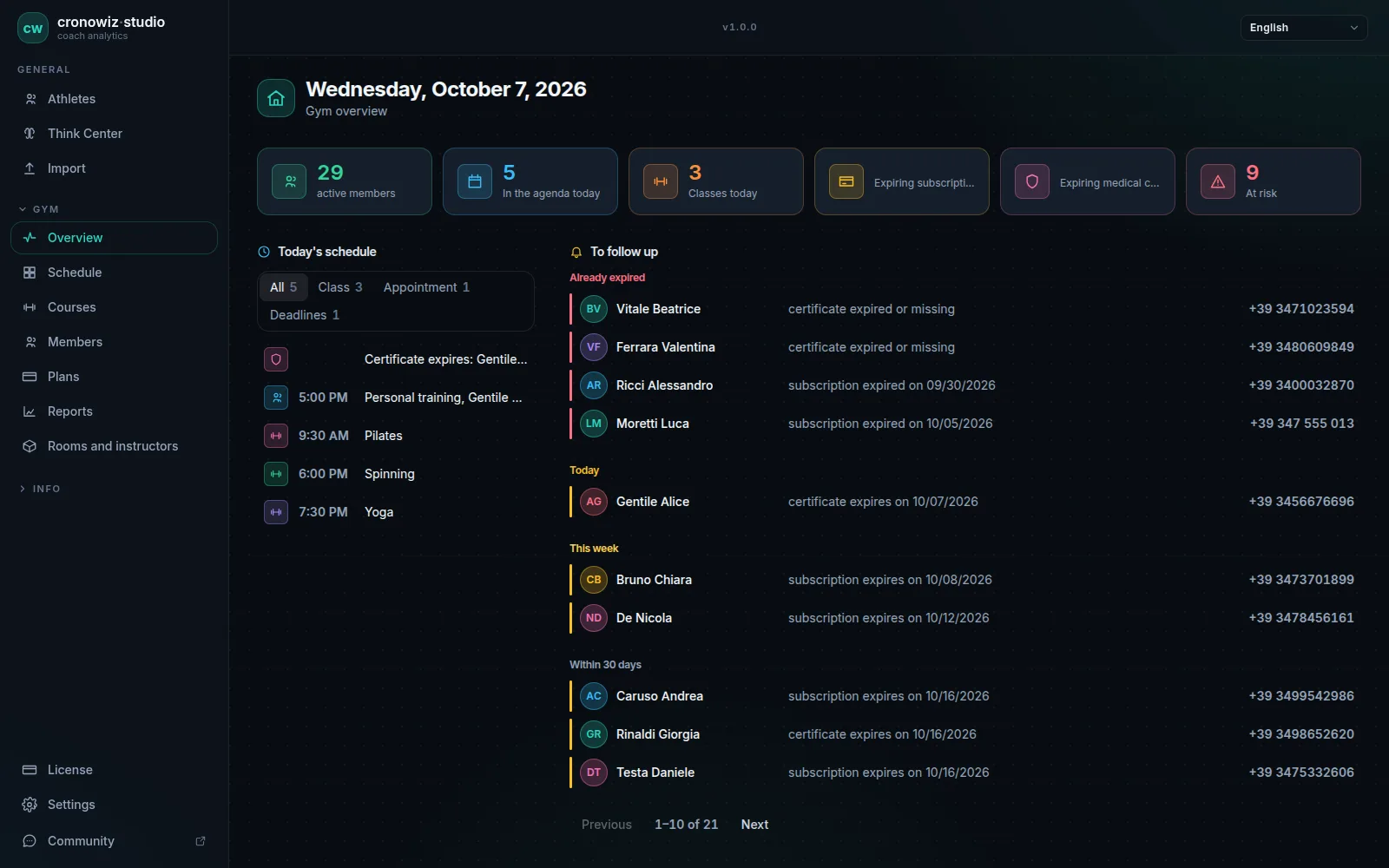
Studio works differently. Member records, memberships, certificates and workouts are kept in a single local database, and the program works offline. The only communication with our servers concerns the licence, and it receives only an anonymous fingerprint of the computer, no gym or member data. Payment for the licence goes through Stripe and concerns whoever buys the program, not your members.
The program costs €199 once. What it does not do should be said too: it does not write your privacy notice, does not collect consent for you and does not encrypt the computer’s disk. The gym remains the data controller, and with the data in-house, the computer’s security is your responsibility.
-
No cloud
member data never leaves the gym’s computer.
-
Anonymous licence check
the licence server only receives an anonymous fingerprint of the computer.
-
Backups under your control
a file you copy wherever you decide, with exact restore.
-
Archive
members who no longer attend can be moved to the archive.
What changes with local data
No outside vendor stores your members’ data, so there is no transfer to third-party servers to document for your gym software. If the software vendor closes down, the data stays on your computer. If a cloud service is breached, your members are not in that database.
For health data such as medical certificates the benefit is concrete: under GDPR it is a special category of data, and keeping it in one place, under your control, makes it easier to say where it is and who can see it.
What is still up to you
Protecting the computer: a user account with a password, system updates, disk encryption (BitLocker on Windows, LUKS on Linux) if the PC could be stolen. Taking regular backups and keeping them somewhere safe, ideally encrypted. Copying the backup to a personal cloud drive puts the data back in the cloud: that is a choice to make knowingly.
Then there are the usual obligations: a privacy notice for members, a lawful basis for processing, a record of processing where required, retention periods. The gym decides these, with an adviser if needed; the gym GDPR compliance checklist goes through them one by one. This page is not legal advice.
Who it is not for
If you need access to the data from a phone or a browser, a local program is inconvenient by design: Studio has no app and no web access, and from home or another site you can only connect from another PC running Studio, over a VPN. In that case a cloud service with a sound data processing agreement is the right route.
Your gym in one program. Your data in your gym.
Windows and Linux · €199 once, no subscription
The questions people usually ask
Is cronowiz Studio GDPR-compliant?
Compliance applies to the gym, not to software alone. Studio helps because it does not send member data to outside servers, but the privacy notice, consent and computer security remain your job.
What data reaches your servers?
Only an anonymous fingerprint of the computer, to check the licence. No member, membership or workout data.
Do I need a data processing agreement with you?
We do not process member data on your behalf, because we never receive it. Check your own situation with your adviser all the same.
Is the database encrypted?
To protect data at rest, encrypt the computer’s disk with the operating system’s tools, such as BitLocker or LUKS.
How do I deal with a former member’s data?
Members can be archived when they stop attending. For retention and deletion, follow the rules set out in your privacy notice.
Can I keep the backup on a USB stick?
Yes, the backup is a file. Protect it with a passphrase when you export it, or use an encrypted drive, and keep it somewhere safe, because it contains all your members’ data.